What is a program? A guide for drug discovery teams
Last updated: November 12, 2026
Introduction
A Program in Pluto is the home for one therapeutic effort: the target or indication you are pursuing, the decisions it is working toward, and every dataset, analysis and plot that informs those decisions. If your team already talks about "the RA program" or "the KRAS G12C program", that is a Program in Pluto.
Programs give every piece of scientific work a place to live and a reason to exist. Instead of results scattered across shared drives and slide decks, each experiment and analysis is linked to the program it serves and the stage that program is in. Your scientists can see what has already been asked and answered, and your leaders get a live, traceable view of how the evidence for each program is building.
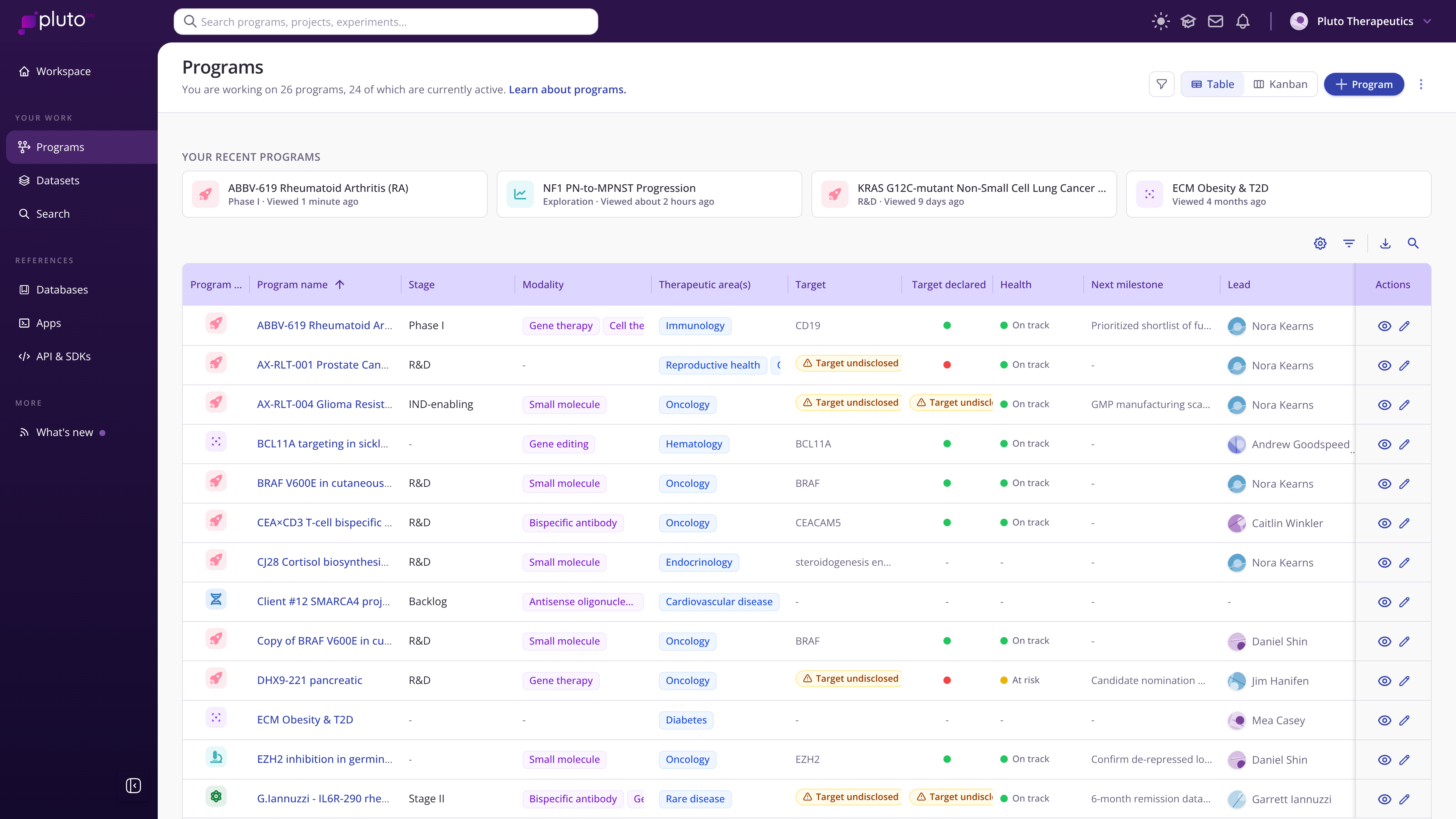
Programs overview
What a program holds
Every program brings together:
Strategy: a description, goals, scope, a timeline and a living program context document.
Evidence: the Translational Alignment Framework™, which shows how well the program's key questions are supported by your data.
Data: a registry of the datasets linked to the program, from your own experiments and from public studies.
Analyses: analysis spaces, each answering one scientific question with organized plots and results.
Targets: the declared target and any target lists your team is evaluating.
People and history: who can view and edit the program, and an audit log of every change.
How a program maps to drug discovery work
Your team says | In Pluto |
|---|---|
"The ABBV-619 rheumatoid arthritis program" | A program |
"We're in IND-enabling" | The program's stage |
"It's a drug discovery program, not a biomarker effort" | The program type |
"Is CD19 still the lead target?" | The Target declared field and target lists |
"What did the synovial fluid RNA-seq show?" | An analysis space in the program |
"Do we have enough mechanistic evidence for the stage gate?" | The program's Framework tab |
Declared target or still searching?
One field shapes how Pluto supports your program more than any other: Target declared.
No: your program is still narrowing in on a target, as in early target discovery, identification and validation. Pluto emphasizes analyses that explore multiple targets and help you rank, score and prioritize a shortlist.
Yes: your program has a declared target. Pluto suggests analyses that build confidence from orthogonal angles: disease relevance, mechanistic and functional evidence, preclinical model alignment, patient population and more.
You can change this field as your program matures.
Where to go next
Programs: creating a program and its fields
Working in an academic lab? See What is a program? A guide for academic labs