What is a program? A guide for academic labs
Last updated: November 12, 2026
Introduction
In an academic lab, the work that matters most is usually organized around a grant: a funded project with specific aims, a timeline and results you will publish. In Pluto, that grant is a Program. One grant, one program.
A program is the home for everything that grant produces: its aims, the datasets you generate or reuse, the analyses that test each hypothesis, and the evidence you will build your papers and progress reports from. Instead of results scattered across lab drives, personal notebooks and the laptop of a student who just graduated, every dataset and analysis is linked to the grant it serves. Your lab can see what has already been asked and answered, and the PI gets a live view of progress on every aim.
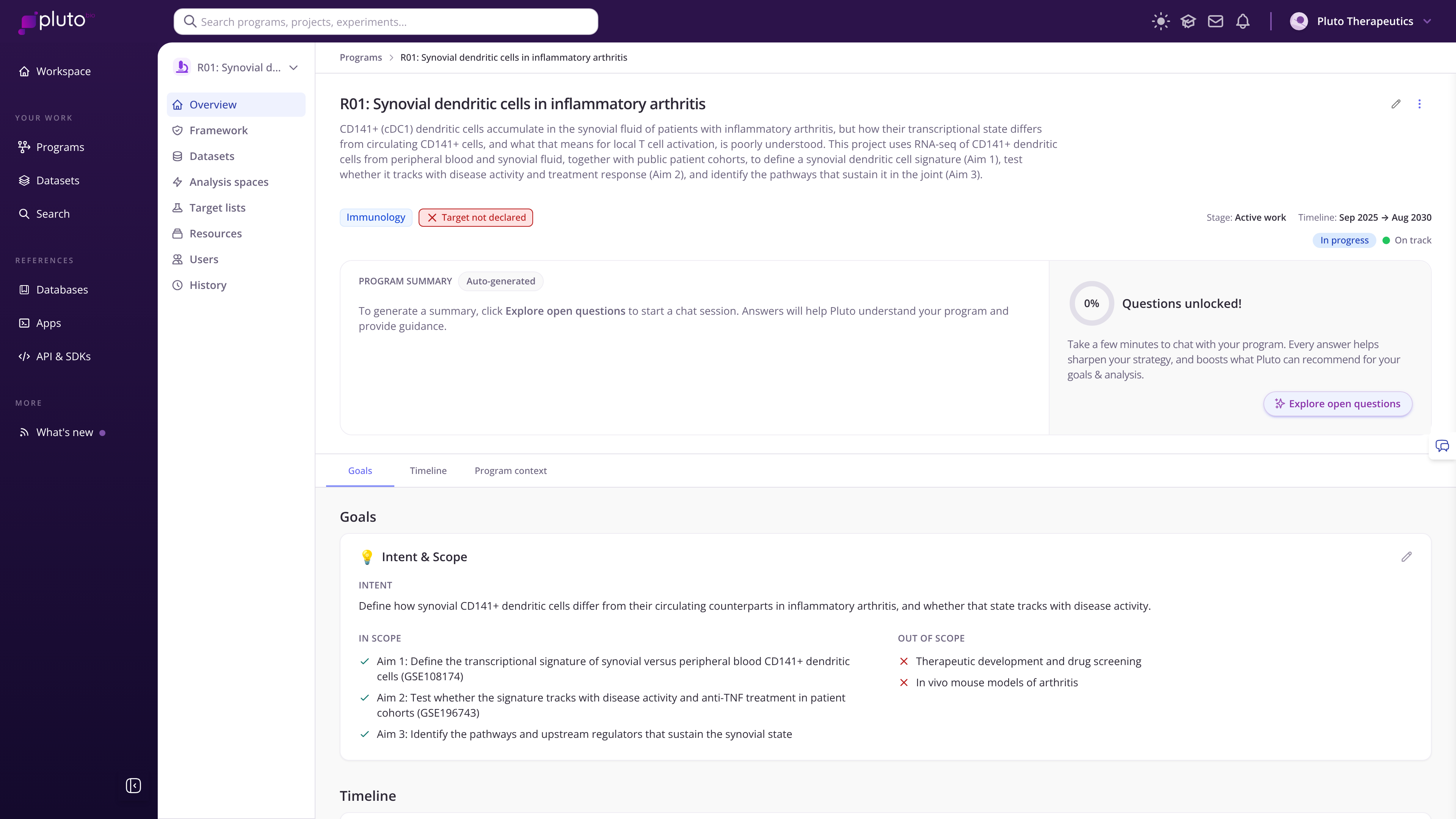
Overview of a grant program, "R01: Synovial dendritic cells in inflammatory arthritis"
What a program holds
Your aims: a description, goals and scope, a timeline and a living program context document.
Your evidence: a framework that shows which of the program's key questions are supported by your data and which still need work.
Your data: a registry of datasets linked to the grant, from your own experiments and from public repositories such as GEO.
Your analyses: analysis spaces, each answering one question, often one per aim or sub-aim.
Your people: who in the lab and among your collaborators can view or edit the program, and a history of every change.
How a program maps to grant-funded research
Your lab says | In Pluto |
|---|---|
"The R01 on synovial inflammation" | A program |
"We're in year 2 and starting to write up Aim 1" | The program's stage |
"Specific Aim 2: define the dendritic cell signature" | A goal, and an analysis space that answers it |
"Let's reuse that GEO dataset from the 2018 paper" | A public dataset linked to the program |
"What changed while I was at the conference?" | The program's History tab |
"Do we have enough preliminary data for the renewal?" | The program's Framework and analysis space summaries |
When a program is not a grant
Most labs find "one grant, one program" the clearest place to start. Some variations work well too:
A multi-site or consortium grant can be one program shared with collaborators at other institutions through the Users tab.
A pilot or internal seed project with no external funding yet can be its own program in an early stage such as Pre-funding.
A training grant or core facility may be better organized by the research questions it supports than by the award itself. Talk to your Pluto solutions engineer about the best fit.
Target declared, for academic projects
Programs have a Target declared field. If your grant is focused on a specific gene, protein or pathway, set it to Yes and Pluto will suggest analyses that deepen confidence in that target from several angles. If your work is exploratory, such as discovering what distinguishes a disease state, set it to No and Pluto will favor analyses that compare and rank many candidates.
Where to go next
Programs: creating a program and its fields
Working in drug discovery? See What is a program? A guide for drug discovery teams